
Date: March 12, 2026
The crypto market is once again caught between macro headwinds and structural tailwinds. Bitcoin slipped below $70,000 overnight as renewed attacks on oil tankers in Iraqi waters sent Brent crude surging back above $100 per barrel, wiping out a brief relief rally from earlier in the week . Yet beneath the surface-level volatility, significant regulatory advancements—including a landmark SEC-CFTC agreement and progress on Hong Kong stablecoin licenses—signal continued institutional maturation .
Price Action: Bitcoin’s $71K Ceiling Holds
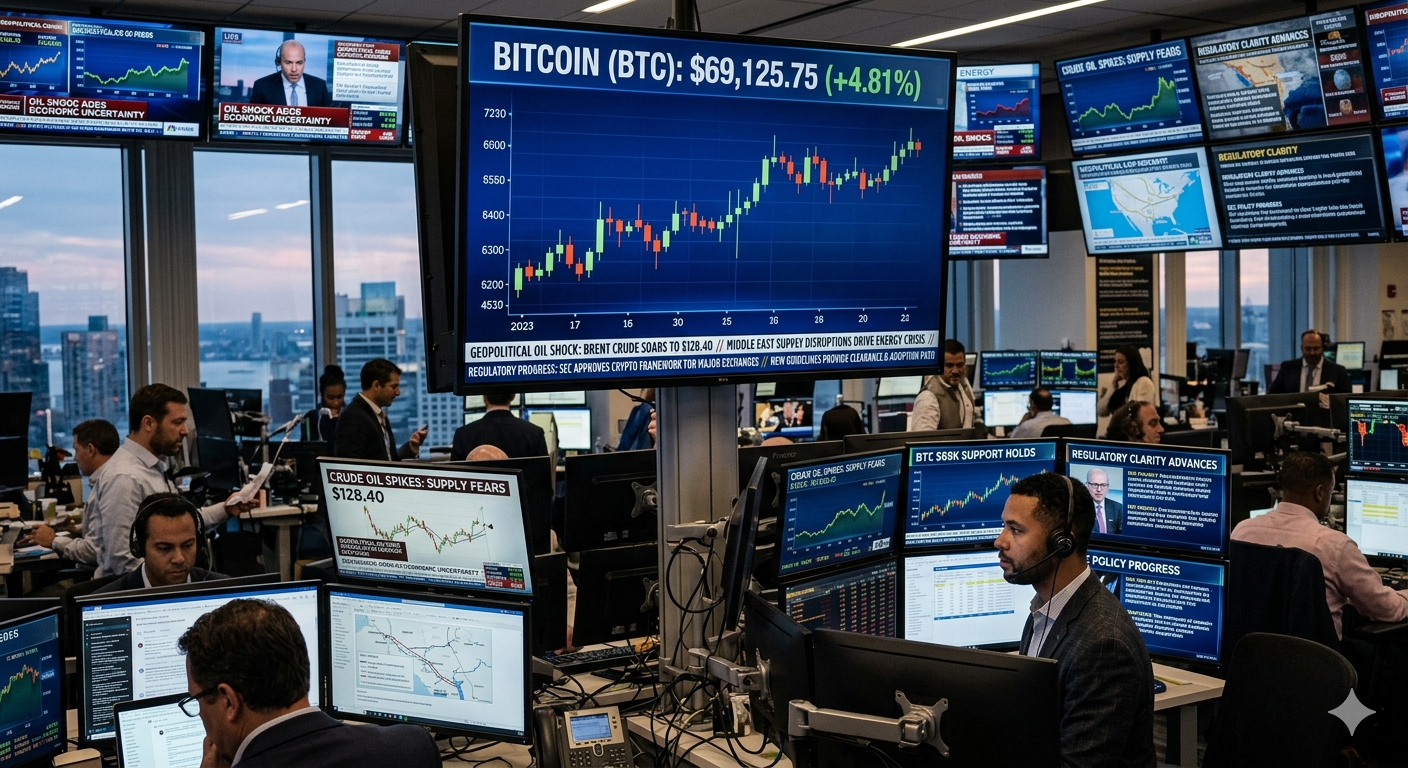
Bitcoin fell to approximately $69,400 during Thursday morning Asian trading, down about 0.8% over 24 hours and extending weekly losses to 4.3% . The move came after reports of attacks on two oil tankers in Iraqi waters, which sent Brent crude soaring as much as 10.5% and reignited stagflation fears .
The pattern has become frustratingly familiar: Bitcoin pushed above $71,000 late Wednesday evening before the tanker headlines hit, dropping nearly $2,000 in a matter of hours. This marks the third time in two weeks that Bitcoin has tested the $71,000-$74,000 resistance zone only to get knocked back by an escalation in the Middle East conflict .
Ethereum fell to approximately $2,025, down 0.5% on the day and 4.5% on the week. Solana dropped 1.5% to $85, now down 5.7% over seven days—the worst-performing major. XRP lost 0.8% to $1.37, while Dogecoin fell 0.8% to $0.092, giving back most of Tuesday’s Musk-driven gains .
The broader crypto market cap remains stable near $2.38 trillion, with the Fear & Greed Index hovering at 27—still in “Fear” territory but slowly improving from recent extremes .
The Macro Backdrop: Oil, Iran, and the Fed
The geopolitical situation remains fluid. Brent crude’s surge past $100 was driven by a combination of the tanker attacks, clearance of the Mina Al Fahal port in Oman, continued hostilities across the Persian Gulf, and growing doubt about whether a proposed IEA reserve release will be large enough to offset supply disruptions .
President Trump suggested earlier this week that the war would resolve “very soon” and that military objectives were “pretty well complete.” But the timeline remains unclear, Iran continues striking targets across the region, and the Strait of Hormuz remains disrupted. Mixed messaging from Washington has left markets unable to price the conflict’s duration with any confidence .
The Federal Reserve’s March 17-18 meeting is now just five days away, and oil back above $100 makes the stagflation case harder to dismiss—and rate cuts even more distant. CME data shows just a 4.5% probability of a March rate cut .
Despite the gloomy headlines, some analysts see opportunity. Andreja Cobeljic, head of derivatives trading at Amina Bank, noted that negative funding rates—payments on perpetual futures contracts—have hit their lowest level in nearly five weeks. “Negative average monthly funding rates have happened only 10 times since 2018, and has historically preceded strong forward returns over longer horizons,” he said. “Whale accumulation has been observed consistently in the low $60,000 range. In combination, the near-term setup for a relief rally is more constructive than the headline environment would suggest” .
Regulatory Breakthrough: SEC and CFTC Sign Historic MOU
In a landmark development for US crypto policy, the Securities and Exchange Commission (SEC) and Commodity Futures Trading Commission (CFTC) have signed a memorandum of understanding committing to enhanced coordination on crypto asset regulation .
Key points from the agreement:
- The MOU aims to “guide coordination and cooperation between the two agencies” to support legitimate innovation, maintain market integrity, and ensure investor and client protection
- Both agencies will work to establish a federal “fit-for-purpose regulatory framework” for crypto assets and other emerging technologies
- They will coordinate to address regulatory obstacles preventing the legitimate launch of new financial products, including those related to crypto assets
SEC Chairman Paul Atkins stated that decades of regulatory turf battles, duplicate registrations, and differing regulations between the two agencies have stifled innovation, driving market participants to other jurisdictions .
While memorandums of understanding are generally non-binding, the formal commitment by both agencies to collaborate closely on crypto policy is widely viewed as a positive signal for digital asset advocates .
FDIC: Stablecoins Under GENIUS Act Get No Deposit Insurance
FDIC Chairman Travis Hill clarified at the American Bankers Association Washington Summit that stablecoins falling under the GENIUS Act will not qualify for any form of deposit insurance, including “pass-through insurance” that financial institutions might seek to obtain on behalf of clients .
Key clarifications:
- The position aligns with the legislative intent of the GENIUS Act, which explicitly distinguishes stablecoins from bank deposits (the latter are guaranteed up to $250,000 by the US government)
- Current pass-through insurance rules require the ability to identify the ultimate customer and their interests during daily operations—a feature large-scale stablecoin arrangements currently lack
- Although stablecoins cannot qualify for FDIC insurance, the law mandates they maintain full reserves protected by issuer safeguards
White House Crypto Advisor Patrick Witt defended the CLARITY Act on X, stating that attempts to turn it into an anti-competition bill are “not advisable.” Jefferies analysts noted this week that stablecoin growth could lead to a 3-5%of core bank deposits over the next five years .
Hong Kong Stablecoin Licenses Imminent
According to multiple sources cited by the Sing Tao Daily, HSBC, Standard Chartered, and local virtual asset trading platform OSL will be among the first companies to receive Hong Kong stablecoin licenses .
Details:
- The list could be announced as early as next week, though it remains subject to change
- The Hong Kong Monetary Authority (HKMA) declined to comment on market rumors
- Previous reports indicated Hong Kong’s stablecoin licensing framework would be introduced shortly after the Two Sessions, with fewer than four licenses expected initially
This represents a significant step in Hong Kong’s ambition to become a regional stablecoin hub.
Ripple Launches $750 Million Share Buyback
Ripple has initiated a share repurchase program of up to $750 million, valuing the company at approximately $50 billion—up from $40 billion in its November funding round .
Key details:
- The tender offer is open to investors and employees and is expected to last until April
- In November, Ripple raised $500 million from investors including Citadel Securities and Fortress Investment Group at a $40 billion valuation
- The buyback follows Ripple’s continued expansion despite ongoing legal clarity around XRP
Bullish Surpasses Coinbase in Spot Volume
In a significant market structure shift, institutional-focused exchange Bullish saw its February spot trading volume reach $76 billion, a 62.6% month-over-month increase, giving it a 5.06% market share and surpassing Coinbase (4.59%) to become the world’s third-largest centralized spot exchange .
Context:
- This marks another milestone for Bullish since its NYSE listing last year
- The gain came despite overall centralized exchange activity slowing, with combined spot and derivatives volumes falling 2.41% in February to $5.61 trillion amid muted volatility
- Binance remains the largest exchange with about 22% spot market share, though its dominance has fallen to the lowest level since 2020 as trading activity spreads across more competing platforms
Wells Fargo Files for WFUSD Trademark
Wells Fargo has filed a cryptocurrency-related trademark application with the USPTO for “WFUSD,” signaling potential expansion into digital asset services .
The filing indicates:
- Services including “cryptocurrency payment processing”
- “Execution of digital asset transactions”
- “Services featuring asset tokenization software”
The name suggests it could be a deposit token or stablecoin. In 2019, Wells Fargo disclosed plans to pilot an internal settlement service called “Wells Fargo Digital Cash” on its proprietary distributed ledger platform .
VanEck Brings Crypto ETFs to 401(k) Plans
VanEck has partnered with fintech platform Basic Capital to include some of its digital asset ETFs in U.S. 401(k) retirement plans .
Details:
- Basic Capital provides corporate 401(k) retirement plan platforms
- The partnership will enable retirement savers to gain exposure to digital assets through ETFs
- VanEck’s crypto products include spot Bitcoin and Ethereum ETFs, an “On-Chain Economy” ETF, and a recently launched spot Avalanche ETF
This represents a significant step in bringing crypto exposure to mainstream retirement savers.
MasterCard Launches Crypto Partnership Program
MasterCard has announced a new global partnership program, enlisting over 85 digital asset companies, payment service providers, and financial institutions including Circle, Binance, and Gemini .
The initiative aims to:
- Integrate crypto payments with MasterCard’s network
- Promote stablecoins as an alternative to traditional payment rails
MasterCard and Visa have been pursuing stablecoin initiatives since 2021, betting on their ability to become indispensable in driving stablecoin adoption for everyday payments .
Ledger Discloses MediaTek Chip Vulnerability
Hardware wallet provider Ledger has disclosed a security vulnerability in MediaTek’s Dimensity 7300 chip .
The risk:
- Attackers with physical access to an Android device could extract hot wallet seed phrases within minutes
- The vulnerability affects devices using the affected chip
- Ledger’s disclosure highlights ongoing security challenges in the hardware wallet ecosystem
Coinbase Lobbying Controversy
According to BitcoinNews reports, Coinbase has allegedly been lobbying U.S. lawmakers behind the scenes to oppose establishing a tax exemption for small Bitcoin transactions and suggesting limiting the exemption to stablecoins only .
The controversy:
- Bitcoin policy advocate Marty Bent disclosed on social media that Coinbase told lawmakers “no one uses Bitcoin as currency”
- Coinbase reportedly argued that a tax exemption for small Bitcoin transactions would be a “subsidy doomed to fail”
- The crypto community considers the situation “very concerning” if true, echoing concerns about regulatory capture
- The Bitcoin Policy Institute warns that restricting tax exemptions to stablecoins would be a “strategic mistake” in U.S. policy
Over the past three months, policy discussions on Capitol Hill have shown notable shifts, with some proposals favoring tax exemptions for small stablecoin transactions while excluding Bitcoin .
Strive Increases Bitcoin Holdings
Publicly traded company Strive has increased its Bitcoin holdings to 13,311 BTC (up from 13,131.82 in January) and purchased $50 million worth of Strategy perpetual preferred shares (STRC) , which currently yield 11.5% .
The company also announced a 25-basis-point increase in its SATA preferred stock dividend to 12.75%, narrowing the price range from $95-$105 to $99-$101. SATA is a high-yield, Bitcoin treasury-backed perpetual preferred instrument traded on Nasdaq .
CZ: Binance Valuation Tracks the Market
Binance founder Changpeng Zhao (CZ) took to social media to address questions about Binance’s valuation following Forbes calculations .
CZ’s key points:
- “As a shareholder, of course I hope Binance’s valuation rises. But the fact is, when crypto market prices fall, Binance’s valuation is hard to increase. Things are actually quite simple.”
- “Binance is the world’s largest crypto exchange—it grows or contracts with the entire industry.”
- “Crypto winter = reduced trading volume. Low crypto prices = reduced trading fees. So from this obvious logic, Binance and I naturally hope the industry develops, or more directly, hope major crypto asset prices rise.”
- “We never short the market or try to ‘suppress prices.’ Even though I no longer manage Binance, I’m still working with governments worldwide to promote crypto industry development.”
CZ also reflected on wealth: “When wealth exceeds a certain threshold (actually not that high), more money doesn’t make you happier. There are more meaningful things in life—like having a healthy body, a loving family, and making a positive impact on the world as much as possible” .
Aptos Enables 30-Minute Development
According to Avery Ching, co-founder and CEO of Aptos Labs, agentic coding on the Aptos blockchain can now be executed in as little as 30 minutes, significantly reducing switching costs for developers .
The development:
- Leverages Aptos’s Move programming language and tools like aptos-agent-skills
- Enables rapid prototyping of on-chain protocols and frontend solutions
- Could accelerate adoption and streamline blockchain development for trading-focused applications
Developer Sergei Sadkov reportedly built a small on-chain social protocol on Aptos in about 30 minutes, including frontend polish using Cursor and Google Stitch, resulting in a project called “Object Vibe” .
Quick Hits: Other Notable Developments
- Grayscale Avalanche Staking ETF begins trading today, offering direct AVAX exposure
- Tether and Lugano continue expanding Bitcoin adoption efforts in the Swiss city
- Michael Saylor hinted at another potential Bitcoin purchase this week
- Stablecoin market cap has surpassed $313 billion, reaching a new all-time high
- On-chain RWA scale (excluding stablecoins) reached $25 billion, up nearly fourfold year-over-year
- 28 U.S. lawmakers signed a letter requesting a permanent CBDC ban
- Treasury Secretary Bessent praised El Salvador’s digital asset development efforts
- Vitalik Buterin emphasized the importance of encryption privacy technology for protecting user API call patterns and behavioral data as AI agents proliferate
- X Card (X Money debit card issued by Visa) is now available for U.S. beta testers, offering 3% cash back
- 深圳龙岗 proposed measures supporting OpenClaw and OPC development with subsidies up to 2 million yuan
- Ho Chi Minh City established a $190 million venture fund prioritizing AI and blockchain investments
What to Watch
Today:
- Continued monitoring of Iran conflict and oil price dynamics
- Potential Hong Kong stablecoin license announcements
- Fed Governor speeches
This week:
- March 13: WLFI governance vote deadline
- March 17-18: Federal Reserve FOMC meeting
- March 20: BTCS launch
Key price levels:
- Bitcoin: Support at $68,000 and $66,000; resistance at $71,000 and $74,000
- Ethereum: Support at $2,000; resistance at $2,100
- XRP: Consolidating between $1.25-$1.45; reclaiming $1.60-$1.70 needed for trend shift
Final Thoughts
March 12, 2026, captures the paradoxical nature of today’s crypto markets: short-term price action hostage to geopolitical headlines , yet long-term structural development accelerating across multiple fronts .
Bitcoin’s repeated failure to hold above $71,000 reflects genuine macro headwinds. The Iran conflict shows no signs of rapid resolution, oil prices threaten to reignite inflation, and Fed rate cuts remain distant . On-chain data confirms the struggle: apparent demand remains deeply negative at -30,800 BTC on a 30-day basis, the bull-bear indicator is still in bear territory, and supply in loss continues to climb .
Yet beneath the price action, the infrastructure build continues. The SEC and CFTC have formally committed to collaborative crypto regulation—a genuine milestone after years of turf wars . Hong Kong is weeks away from issuing its first stablecoin licenses to global banking giants . Ripple’s $50 billion valuation and Bullish surpassing Coinbase in volume demonstrate that crypto enterprises are maturing into serious financial institutions . And MasterCard is building a global partnership program with over 85 crypto companies .
As Amina Bank’s derivatives head noted, the negative funding rates and whale accumulation suggest a more constructive setup than the headline environment would imply . But as CoinDesk’s chart shows, every bounce still gets sold into by holders looking to exit .
For investors, the message is clear: volatility is the price of admission, but the foundation for the next growth phase continues taking shape—even as traders watch oil prices and wait for the next headline from the Middle East.
Disclaimer: The above content is for informational purposes only and does not constitute financial advice. Investing in cryptocurrencies involves significant risk. Please conduct your own research before making any investment decisions.
 By
By


 By
By