
Date: April 2, 2026
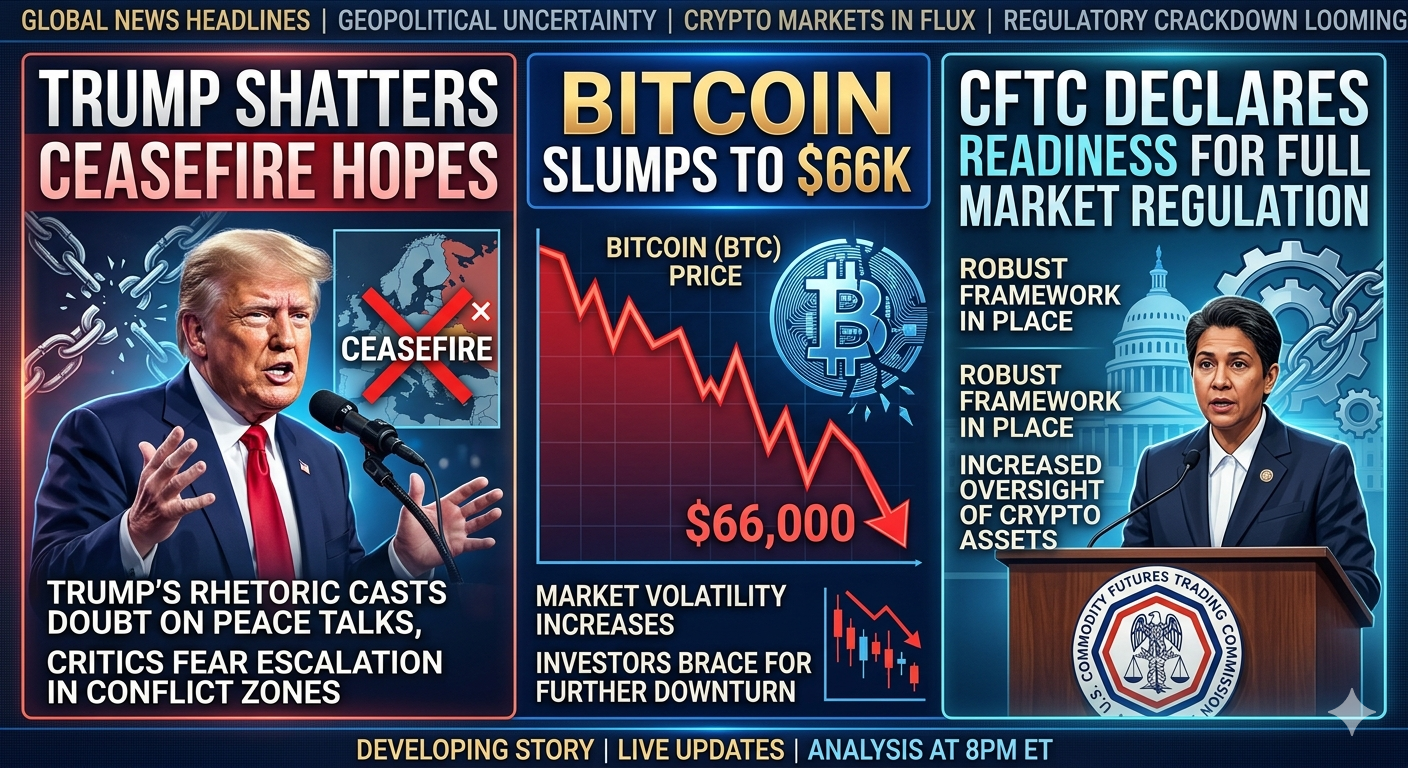
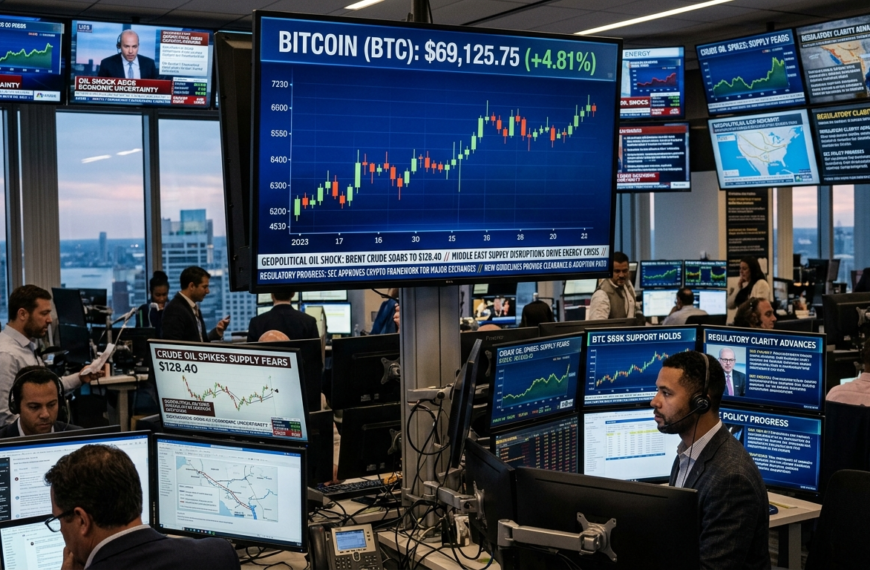
The crypto market suffered a sharp reversal today as President Trump’s national address on the Iran conflict dashed widespread expectations of an imminent ceasefire, sending Bitcoin tumbling back toward $66,000. The selloff triggered over $420 million in liquidations, while oil prices surged past $106 per barrel, reigniting inflation fears and cooling hopes for Federal Reserve rate cuts .
Yet beneath the geopolitical turbulence, significant structural developments continued: the CFTC declared its readiness to regulate the entire $3 trillion crypto industry, the Treasury Department released the first GENIUS Act implementation rules, and the SEC approved multi-crypto asset trust options for the first time .
Market Overview: Trump’s “About-Face” Triggers Broad Selloff
The crypto market turned sharply lower following President Trump’s nationwide televised address at 9:00 AM Beijing time on April 2 (9:00 PM EST April 1). Contrary to market expectations that Trump would signal a path toward de-escalation, he warned that the United States would launch “extremely fierce” strikes against Iran within the next two to three weeks .
Market reaction was immediate and severe :
- Bitcoin (BTC): Fell 3.41% to approximately $66,570, erasing gains from the previous two days
- Ethereum (ETH): Dropped 4.03% to $2,048, approaching the critical $2,000 psychological level
- Solana (SOL): Declined nearly 6% to $78.93, becoming the worst performer among top cryptocurrencies
- BNB: Fell 4.39% to $589.13
- XRP: Declined 2.36% to $1.30
Liquidations surged : Over the past 24 hours, total liquidations across the crypto market exceeded $420 million, with long positions accounting for approximately $249 million (nearly 60%) of that total. Over 140,000 traders were liquidated as the sudden reversal caught bullish positions off guard .
The broader crypto market cap fell approximately 2.6% to $2.37 trillion, while the Crypto Fear and Greed Index dropped to 27—firmly in “Fear” territory—reflecting a clear reduction in risk appetite .
The Geopolitical Backdrop: Oil Surges, Rate Cut Hopes Fade
The market selloff was exacerbated by a sharp spike in energy prices. Brent crude oil surged more than 5%, climbing above $106 per barrel, as Trump’s remarks raised the prospect of strikes on Iranian energy infrastructure and continued disruption of the Strait of Hormuz .
Key geopolitical developments :
- Iran’s response: Iranian Foreign Minister Araghchi stated that Iran does not accept a ceasefire, only a “complete end to the war” with guarantees against future aggression. The Revolutionary Guard declared that the Strait of Hormuz remains fully under Iranian control and will not be opened due to Trump’s “absurd performance.”
- Negotiation stalemate: Iranian sources indicated that Tehran would only agree to ceasefire talks if a permanent end to the war is guaranteed. US intelligence agencies assessed that Iran currently has no interest in substantive negotiations, believing it holds a favorable position in the conflict.
- NATO tensions: Trump also stated he is “seriously considering” withdrawing the United States from NATO, citing the alliance’s refusal to join his military campaign against Iran.
The oil price surge has reignited inflation concerns, directly impacting Federal Reserve policy expectations. CME data shows a 97.4% probability that the Fed will maintain current interest rates at its April meeting, with the probability of a June rate cut also diminishing as energy-driven inflation pressures mount .
Regulatory Breakthrough: CFTC Declares Readiness to Regulate Entire Crypto Market
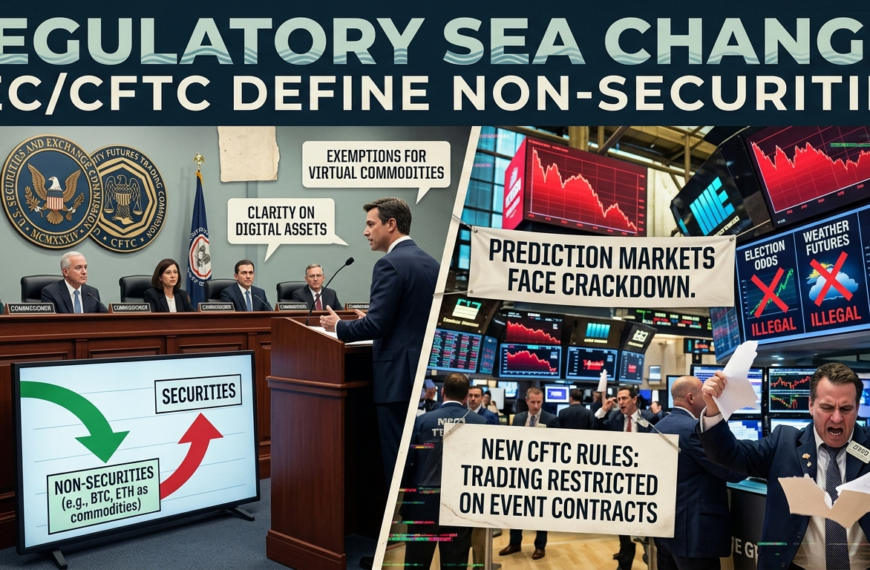
In a landmark statement that cuts through the geopolitical noise, CFTC Chairman Michael Selig declared that the agency is prepared to regulate the entire $3 trillion cryptocurrency industry .
Key points from Selig’s statement :
- The CFTC is “ready to take on responsibility” for comprehensive crypto market regulation
- Selig reiterated that the CFTC is the sole regulator of prediction markets
- Under Selig’s leadership, the CFTC has implemented policies indicating a more relaxed enforcement and regulatory stance toward digital assets compared to the previous administration
- Last month, the agency signed a Memorandum of Understanding (MoU) with the SEC to coordinate regulatory efforts, including those related to digital assets
However, Selig noted that Congress has not yet established a timeline for passing key market structure legislation, leaving the full transfer of authority pending legislative action .
Treasury Department Releases First GENIUS Act Implementation Rules
The U.S. Department of the Treasury released its first Notice of Proposed Rulemaking (NPRM) for the GENIUS Stablecoins Act, seeking public comments on criteria for determining whether small stablecoin issuers qualify for state-level regulatory frameworks .
Key provisions of the draft rules :
- Stablecoin issuers with issuance volumes below $10 billion may opt for state regulation over full federal oversight
- State-level regulatory systems must be “substantially similar” to the federal framework to qualify
- The public will have a 60-day comment period following publication of the rule in the Federal Register
- The FDIC and OCC are also releasing draft rules to advance stablecoin regulatory implementation
Important limitation: The GENIUS Act does not yet cover regulations for interest-bearing stablecoins, which has become a significant obstacle for Congress in advancing broader cryptocurrency market structure legislation .
SEC Approves Multi-Crypto Asset Trust Options
The SEC announced approval of a rule change application by NYSE American to list options on multi-cryptocurrency commodity trusts .
Key details :
- Previously, only options on trusts holding a single cryptocurrency asset were allowed
- The new rule expands the scope to include trusts holding multiple cryptocurrency assets
- Listing prerequisites: each cryptocurrency asset must meet high liquidity standards (average daily market value of at least $700 million over the past 12 months)
- Derivative contracts for the cryptocurrency asset must trade on platforms with comprehensive surveillance-sharing agreements
The SEC concluded that this rule change will provide investors with greater exposure to cryptocurrency assets and hedging tools without requiring separate SEC approval for each instance, thereby enhancing market efficiency .
CLARITY Act Faces Growing Headwinds
The outlook for the Digital Asset Market CLARITY Act has darkened significantly, with TD Cowen managing director Jaret Seiberg expressing “increasing pessimism” about its prospects .
Key challenges :
- Seiberg estimates only a one-third probability that the Senate will advance the bill and the House will pass it
- Congress has entered a two-week Easter recess, further delaying progress
- The recently proposed compromise on stablecoin yields (prohibiting yields on static balances while allowing activity-based rewards) is considered “insufficient” to break the stalemate
- Senator Mark Warner has lowered his passage probability estimate from 80% to 50-60%
Cardano founder Charles Hoskinson issued a strong critique of the CLARITY Act, warning that even if passed, it could require up to 15 years of rulemaking and implementation, leading to prolonged industry stagnation . He further warned that the legislation could be “weaponized” by future administrations against specific projects or industry participants.
Major Security Incident: Drift Protocol Hacked for $200M+
The Solana ecosystem suffered one of its largest DeFi hacks to date, with Drift Protocol losing at least $200 million (with some estimates approaching $270 million) in a sophisticated attack .
Details of the incident :
- The attack targeted the Solana-based derivatives trading platform
- Multiple pools and various crypto asset types were affected
- The project team has identified the anomaly and is investigating, warning users not to deposit additional funds into the protocol
- The platform emphasized that this is “not an April Fool’s joke”
SlowMist founder Yu Xian commented that all DeFi project teams should urgently review what extreme scenarios could arise if their owner/admin private keys are compromised, and ensure they have timely alerting and response mechanisms in place .
This attack is potentially the largest DeFi security incident on Solana since the Wormhole bridge attack.
Q1 2026 Venture Capital Trends: Prediction Markets Dominate
Venture capital funding in the crypto sector showed significant sectoral shifts in Q1 2026, according to Octopus analysis .
Q1 2026 VC funding breakdown :
- Prediction markets: $1.67 billion (3 deals) — dominated by Kalshi’s $1B+ raise
- Payments: $679 million (9 deals)
- Trading: $418 million (6 deals)
- DeFi: $337 million (8 deals)
Overall trend : Total VC funding fell 12% year-over-year, but capital is shifting toward more substantive, revenue-generating sectors rather than speculative infrastructure plays.
Prediction market growth : Trading volume in prediction markets reached $75 billion in Q1 2026, a new record high representing a 70.45% increase compared to Q4 2025. The sector has grown from zero to $75 billion in just two years .
Corporate and Institutional Developments
Morgan Stanley Bitcoin ETF Progress: Morgan Stanley resubmitted an S-1 amendment for its Bitcoin ETF, with analysts expecting the fund to launch as soon as next week. This would mark the entry of another major traditional finance player into the spot Bitcoin ETF arena .
EDX Markets Seeks National Charter: EDX Markets, the cryptocurrency exchange backed by Citadel Securities, Fidelity Investments, and Charles Schwab, has applied to the OCC for a national trust bank charter. CEO comment: obtaining an OCC-chartered trust license would give it a competitive advantage in serving large banking clients .
Bithumb Delays IPO: South Korean crypto exchange Bithumb has postponed its IPO plans to 2028, further delaying from the previously anticipated second half of 2025. The exchange is still in the preparation stage, focusing on strengthening accounting policies and internal controls following an incident where it mistakenly distributed approximately 620,000 Bitcoins (worth ~$43 billion) during a promotional event .
Paradigm Building Prediction Market Terminal: Crypto venture capital firm Paradigm is developing a prediction market trading terminal aimed at professional traders and market makers, led by partner Arjun Balaji since late 2025. The firm is also evaluating the possibility of establishing its own prediction market market-making operations .
SpaceX IPO News: Elon Musk’s SpaceX has reportedly filed a confidential IPO application, with a potential June listing. The IPO could value SpaceX at over $1.75 trillion, with plans to raise more than $75 billion .
Bitmine ETH Purchase: Bitmine Immersion Technologies purchased 45,000 ETH through BitGo at a value of approximately $95.3 million .
International Regulatory Developments
Australia Passes First Comprehensive Crypto Law: Australia has passed its first comprehensive crypto regulatory bill, requiring crypto exchanges and custody platforms to apply for financial services licenses from local regulators, with compliance required within six months. The new law establishes clear categories for regulated entities and applies the same customer asset protection and disclosure rules as securities firms and fund managers .
Hong Kong Stablecoin Licenses Delayed: The first batch of Hong Kong compliant stablecoin issuer licenses—previously expected in March—has been delayed. The Hong Kong Monetary Authority stated it is “fully advancing” the licensing process but did not provide a new timeline .
Arizona Crypto Bills Advance: Arizona cryptocurrency-related bills have passed the House Rules Committee and will soon proceed to a full House vote. One bill would allow the state’s financial funds to invest up to 10% in crypto assets, while another would establish a state digital asset reserve fund .
Quick Hits: Other Notable Developments
- Riot Platforms reportedly sold another 500 Bitcoins, valued at approximately $34.13 million
- Empery Digital sold 370 Bitcoins last week (generating ~$24.7 million) and released 1,800 BTC previously held as collateral after repaying its term loan
- CoinShares completed its SPAC merger with VineHill Capital and will begin trading on Nasdaq under ticker CSHR, with a valuation of approximately $1.2 billion
- Franklin Templeton announced it will acquire 250 Digital (spun out from CoinFund) to expand its crypto investment product offerings
- Mercado Libre will shut down its Mercado Coin token on April 17, ending a nearly four-year crypto experiment, but will continue offering stablecoin transfers and crypto trading
- New Hampshire plans to issue what appears to be the first rated Bitcoin-backed bond, with Moody’s assigning a preliminary Ba2 rating. The bonds are backed by Bitcoin custodied at BitGo
- Dormant Bitcoin whale moved over 600 BTC (valued at approximately $39.6 million) after more than a decade of inactivity, raising questions about potential selling pressure
- WisdomTree stated that the CLARITY Act is not a prerequisite for advancing tokenization efforts, noting that innovation can continue within existing regulatory frameworks
What to Watch
Today/Tomorrow :
- U.S. Non-Farm Payrolls (March) report — key macro catalyst that could trigger further volatility
- Continued monitoring of Iran conflict developments and oil prices
- Potential Morgan Stanley Bitcoin ETF launch next week
- Bitcoin: Critical support at $65,000-$66,000; break below could open move toward $60,000 (February lows)
- Ethereum: Key psychological support at $2,000
- Resistance: Bitcoin faces overhead resistance at $69,000 (pre-speech level) and $71,000
Fed watch: CME data shows 97.4% probability of rates unchanged in April; strong jobs data could further reduce rate cut expectations
Final Thoughts
April 2, 2026, captures the extraordinary fragility of crypto markets in a geopolitically charged environment. Bitcoin’s sharp reversal following Trump’s national address demonstrates how sensitive digital assets remain to headlines from the Middle East—a sensitivity magnified by thin liquidity and the lingering “Extreme Fear” sentiment that has persisted for weeks .
Yet beneath the surface-level price volatility, the regulatory and institutional infrastructure continues to advance at remarkable speed. The CFTC has declared its readiness to regulate the entire $3 trillion industry. The Treasury Department is implementing the GENIUS Act. The SEC has approved multi-crypto asset options. And Australia has passed its first comprehensive crypto law .
The prediction market sector has grown from zero to $75 billion in quarterly trading volume in just two years . Paradigm is building professional trading terminals for the space. And Morgan Stanley is on the verge of launching its own Bitcoin ETF .
For investors, the current environment demands patience. Bitcoin’s first-quarter decline of 23.8% was the worst since 2018 . Demand metrics remain negative, with apparent demand at approximately -63,000 BTC . Yet as Fidelity Digital Assets notes, this cycle’s drawdown of approximately 50% is far smaller than historical 80-90% retracements—suggesting that while upside volatility may be diminishing, downside risk has also significantly decreased .
The coming days bring critical catalysts: the U.S. jobs report, further geopolitical developments, and the potential Morgan Stanley ETF launch. Each could tip the balance in a market already stretched thin between fear and the foundations of long-term structural growth.
Disclaimer: The above content is for informational purposes only and does not constitute financial advice. Investing in cryptocurrencies involves significant risk. Please conduct your own research before making any investment decisions.
 By
By



 By
By