
Introduction
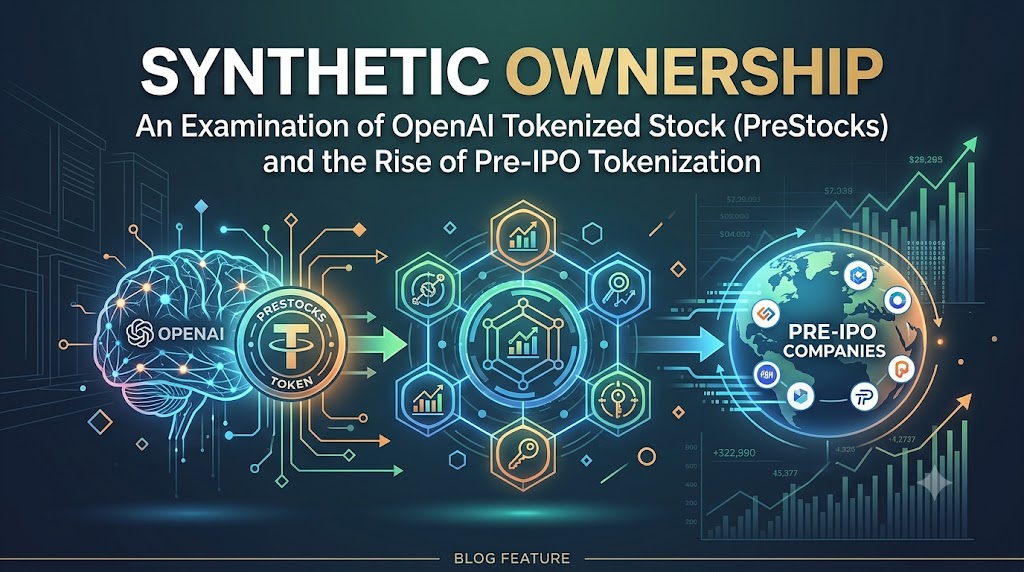
In the summer of 2025, a small blockchain startup called PreStocks quietly began offering something that had, for decades, been the exclusive province of venture capitalists, sovereign wealth funds, and the ultra-wealthy: fractional, tradable exposure to the valuation of the world’s most sought-after private companies. Among the assets it listed was a token simply called OPENAI — a blockchain-based instrument designed to track the implied value of OpenAI’s private shares. On paper, the pitch was seductive.
A retail investor in Manila, Lagos, or Berlin could, with a few dollars in a Solana wallet, buy a sliver of “exposure” to the company behind ChatGPT without needing six-figure minimums, accredited-investor status, or a relationship with a venture fund. In practice, the product sits at the center of one of the more contentious and legally ambiguous corners of modern finance: the tokenization of private equity that the underlying company never agreed to sell.
This essay examines what OpenAI tokenized stock actually is, how the platform that issues it — PreStocks — structures the product, why OpenAI itself has publicly and repeatedly disowned any connection to such tokens, and what the broader phenomenon of unauthorized pre-IPO tokenization reveals about the collision between decentralized finance and traditional corporate equity law.
It is, at its core, a story about the gap between economic exposure and ownership, and about what happens when that gap is marketed to retail investors as something close to the real thing.
What Exactly Is Being Sold
The essential fact, stated plainly in the framing of this topic, is that OPENAI is not an OpenAI security in any legal sense. It is a synthetic financial product manufactured by a third party that has no formal relationship with OpenAI. Understanding why this distinction matters requires understanding the mechanics of how PreStocks and platforms like it actually construct these tokens.
PreStocks does not simply invent a number and let people bet on it. According to the company’s own public materials and interviews with its founder, Xavier Ekkel, the platform creates special purpose vehicles, or SPVs, that acquire actual shares of pre-IPO companies through private secondary-market transactions.
Once an SPV holds a real equity stake — however small — PreStocks issues blockchain tokens on the Solana network that represent proportional interests in that vehicle. In theory, this gives the token a real economic anchor: the SPV owns something, and the token owner owns a claim on the SPV. In this sense, PreStocks describes its structure as a “custodial” model, distinguishing it from purely “synthetic” tokenization approaches that merely reference a company’s price without holding any underlying asset at all.
Regulators, including the U.S. Securities and Exchange Commission in guidance issued in early 2026, have themselves drawn a line between these two structures, since custodial tokenized “security entitlements” and synthetic security-based swaps sit under different regulatory frameworks.
But the custodial structure, however real the underlying shares may be, still leaves the retail buyer several steps removed from the company itself. A person purchasing an OPENAI token on Jupiter or Raydium does not own OpenAI stock. They own a token that represents a claim on an SPV, which in turn owns a stake acquired somewhere on the secondary market, the size and provenance of which is not independently verifiable by the buyer in real time.
There is no shareholder registry entry, no board-approved transfer, no cap-table update, and critically, no consent from OpenAI to any of the transactions that make the token possible. The company whose name is on the label is, in the fullest sense, a bystander to its own tokenization.
The Mechanics of PreStocks
PreStocks launched its Solana-based platform in August 2025 with an initial slate of tokens covering some of the most hyped private technology companies in the world — SpaceX, OpenAI, Anthropic, xAI, Anduril, Discord, Kraken, Neuralink, Epic Games, Databricks, Perplexity, and Figure AI among them.
The pitch was explicitly democratizing: no accreditation requirements, no minimum investment (trades could theoretically start at a penny), no lock-up periods, and continuous 24/7 trading, in sharp contrast to traditional pre-IPO secondary marketplaces like EquityZen or Forge Global, which typically require tens of thousands of dollars and impose transfer restrictions modeled on securities law compliance.
The company built its infrastructure around Solana’s low transaction costs and high throughput, and it quickly partnered with Jupiter, the dominant decentralized exchange aggregator in the Solana ecosystem, to give its tokens meaningful liquidity from day one.
Backed by a modest seed round of roughly two million dollars led by Republic Capital, PreStocks positioned itself less as a broker-dealer and more as a protocol: a set of smart contracts and legal wrappers that mint and burn tokens against SPV holdings, while allowing the tokens themselves to circulate freely across decentralized exchanges, lending protocols, and wallets without ongoing KYC for smaller retail holders. Only large institutional participants who want to mint new tokens directly, or redeem large positions for cash, are required to go through identity verification.
Redemption is where the structure’s real-world tether becomes visible, and also where its limitations show most clearly. A holder wanting to cash out a large position cannot simply sell into infinite liquidity; they must submit a KYC-gated redemption request, pay a non-refundable processing fee, have their tokens frozen, and wait for the SPV to actually sell the corresponding shares on an off-chain secondary market — a process explicitly designed to start with “the riskiest holdings” and attempt to meet a price floor the investor specifies.
This is a meaningful admission embedded in the platform’s own mechanics: despite marketing language about 24/7 liquidity, real redemption at scale depends on the illiquid, slow-moving private secondary market for OpenAI shares, which is itself subject to the company’s transfer restrictions, right-of-first-refusal provisions, and general reluctance to see its cap table diluted by parties it never approved.
Because PreStocks is not registered as a U.S. broker-dealer and does not conduct a public securities offering in the way American law requires, it structures its tokens under Regulation S, an SEC exemption for securities offerings conducted entirely outside the United States.
This is why nearly every platform in this space — PreStocks, Robinhood’s European tokenized offerings, and similar competitors — explicitly blocks U.S.-based users. The tokens are, in effect, designed to exist in a regulatory gap: available to a French or Singaporean retail trader with a crypto wallet, but off-limits, at least officially, to an American one, because bringing the product within U.S. borders would trigger the full weight of domestic securities regulation.
OpenAI’s Position: A Company That Says No
Perhaps the most important context for understanding OPENAI tokens is not the mechanics of the platform issuing them, but the company’s own explicit and repeated rejection of the entire premise. This story became publicly prominent not through PreStocks itself, but through a nearly identical controversy involving Robinhood, which in July 2025 unveiled tokenized “OpenAI” and “SpaceX” shares to European users at a splashy product event in Cannes, sending its own stock to an all-time high in the process.
OpenAI’s response was immediate and unambiguous. The company stated publicly that <cite index=”17-1″>”These ‘OpenAI tokens’ are not OpenAI equity. We did not partner with Robinhood, were not involved in this, and do not endorse it. Any transfer of OpenAI equity requires our approval—we did not approve any transfer.”</cite> This is a company explicitly asserting a legal right that many private firms hold: the ability to block or restrict transfers of their own equity, a mechanism commonly implemented through rights of first refusal written into shareholder and option agreements.
When Robinhood’s CEO, Vlad Tenev, responded that the tokens were never meant to represent literal equity but rather to <cite index=”14-1″>give retail investors indirect exposure to private assets through Robinhood’s ownership stake in a special purpose vehicle</cite>, the underlying admission was telling: even Robinhood’s own leadership conceded, when pressed, that the product did not confer equity, only price-tracking exposure manufactured through a corporate wrapper.
This is structurally identical to what PreStocks offers, and it is worth being explicit that OpenAI’s objection was not to Robinhood specifically but to the practice as a whole — unauthorized third parties packaging exposure to the company’s private valuation and selling it to the public under the company’s name.
Industry commentary following the episode noted that OpenAI’s stance reflected concerns that extend well beyond one platform: investor confusion about what they are actually purchasing, the reputational risk to OpenAI if a token product later collapses or draws regulatory action despite the company having no involvement in it, and the precedent such offerings set for challenging the control private companies have traditionally exercised over who can claim a stake in their capitalization. <cite index=”13-1″>Analysts observed that many investors in these products may mistakenly believe token ownership confers shareholder rights, when in practice holders typically have no voting rights, no access to company information, and no legal recourse tied to the underlying business.</cite>
OpenAI was not alone in this reaction. Elon Musk, a co-founder of both OpenAI and SpaceX, dismissed similar tokenized SpaceX offerings as illegitimate, and the humanoid-robotics company Figure AI went further still, issuing formal cease-and-desist letters to brokers running unauthorized secondary markets in its stock.
The pattern across the industry is consistent: fast-growing, high-valuation private companies with tightly controlled cap tables are increasingly finding that the very desirability of their equity has made them targets for tokenization schemes they never sanctioned, and their response has uniformly been to distance themselves publicly and assert that no legitimate transfer has occurred.
It should be noted that PreStocks has, in interviews, tried to position itself as more issuer-conscious than Robinhood’s approach, with its founder acknowledging the pushback Robinhood received over its OpenAI token and framing “issuer alignment” as something the industry needs to take seriously going forward.
Whether this represents a genuine shift toward seeking cooperation from the companies being tokenized, or simply a public-relations adjustment in language while the underlying practice of acquiring shares without the issuer’s blessing continues, remains an open question. As of the most recent reporting, there is no public indication that OpenAI has entered into any formal arrangement with PreStocks any more than it did with Robinhood.
The Regulatory Landscape
The rise of platforms like PreStocks has occurred against the backdrop of a regulatory environment that is shifting, but still deeply unsettled. In the United States, SEC Chair Paul Atkins has publicly described tokenization as a potentially transformative innovation for capital markets and has signaled the agency’s interest in providing clearer rules for tokenized real-world assets. At the same time, industry groups such as the Securities Industry and Financial Markets Association have pushed back, urging the SEC to reject tokenized equity products that bypass the transparent, disclosure-driven processes that govern traditional securities offerings.
The SEC’s January 2026 guidance attempting to distinguish custodial tokenization models, like the one PreStocks says it uses, from purely synthetic derivative models was an early attempt to bring some taxonomy to a market that had, until then, been operating largely by analogy and improvisation.
In the European Union, looser rules around retail access to certain investment products — the same rules Robinhood cited when it made its tokens available to EU users but not American ones — have effectively made Europe (along with much of the non-U.S. world) the default market for these products. This creates an odd asymmetry: American technology companies whose value is most directly at stake, and whose employees and investors are overwhelmingly domestic, find their equity being synthetically traded by a retail public that U.S. law was specifically designed to exclude from this kind of high-risk, low-disclosure private-market exposure.
The Regulation S exemption that makes this legal is intended to keep unregistered securities offerings out of U.S. markets — not necessarily to create a permanent workaround that lets the same economic activity occur just outside U.S. borders while still referencing U.S. companies by name.
The deeper regulatory tension is definitional. Is an OPENAI token a security at all, and if so, whose security is it — a claim on OpenAI, or a claim on the SPV that happens to hold OpenAI shares? Is it a derivative, a security-based swap, a form of fractionalized real-world asset, or something genuinely novel that existing categories do not cleanly capture? Different jurisdictions, and even different regulators within the same jurisdiction, have offered different answers, and platforms have largely structured their products to exploit whichever gaps currently exist rather than to fit neatly into an established box.
This ambiguity is not incidental to the business model; in a meaningful sense, it is the business model. A fully regulated, fully disclosed, issuer-authorized product would look much more like existing venture secondary marketplaces — slower, more expensive, and far less accessible to a retail trader with a crypto wallet and a few dollars in stablecoins.
What Buyers Are Actually Getting — and Not Getting
Strip away the blockchain terminology and the underlying proposition is straightforward: buyers are purchasing a bet on a number. That number is meant to approximate what OpenAI’s private shares are worth, based on signals like the company’s most recent funding rounds, secondary market transactions, and general sentiment about its prospects — including speculation about a future IPO.
But the token itself confers none of the rights that traditionally justify calling something an “investment” in the fullest sense. There are no voting rights, meaning token holders have no say in how OpenAI is governed. There is no access to material non-public information, meaning holders are trading on public sentiment and rumor rather than the kind of disclosure that would normally accompany a real equity stake.
There are no dividends, which is a moot point for a company like OpenAI that does not currently distribute profits to shareholders, but it underscores the broader principle that the token carries none of the standard bundle of rights associated with corporate ownership.
And critically, there is no guarantee that the token’s price will track OpenAI’s actual valuation with any precision, since the token trades on its own supply and demand dynamics across thinly traded decentralized exchanges, which can diverge sharply from whatever the underlying SPV’s shares are genuinely worth on a given day.
This divergence is not theoretical. Prices for the OPENAI token, as tracked by data aggregators like CoinMarketCap, CoinGecko, and various exchange listing pages, have shown extraordinary volatility — swinging from the mid-hundreds of dollars to well over a thousand dollars per token within a matter of weeks, with daily trading volumes that are, in absolute terms, tiny relative to what one would expect from a genuinely liquid market tracking a company reportedly worth hundreds of billions of dollars.
Thin liquidity of this kind means prices can be moved dramatically by relatively small trades, and it means the token’s price is, at best, a noisy and unreliable proxy for whatever OpenAI’s actual private valuation happens to be at any given moment. Investors treating the token price as a real-time barometer of OpenAI’s worth are, in a meaningful sense, mistaking a thinly traded derivative for the thing it claims to represent.
There is also a structural risk specific to the SPV model itself. The token’s value depends entirely on the SPV’s ability to acquire, hold, and eventually liquidate real shares. If the SPV’s holdings are smaller than the outstanding token supply implies, if the shares were acquired through a secondary transaction that OpenAI later contests or blocks under its right of first refusal, or if the SPV structure faces legal or regulatory action, token holders could find themselves holding a claim on very little.
Redemption, as described earlier, is not instantaneous even for KYC-verified large holders; it depends on the SPV successfully selling shares in an illiquid private secondary market that may itself be affected by exactly the kind of controversy that surrounds unauthorized tokenization in the first place.
Some platforms attempt to address this transparency gap with third-party attestation reports meant to verify that tokens are backed one-to-one by underlying SPV assets, but attestations of this kind are only as good as their frequency, rigor, and independence, and they do not substitute for the kind of audited, continuously updated disclosure that public securities require by law.
Read More About Hype
Why the Practice Persists Despite the Pushback
Given OpenAI’s explicit objections and the clear risks to retail buyers, it is worth asking why platforms like PreStocks continue to operate, and even to grow, in this space. Part of the answer lies in genuine, unmet demand. OpenAI has, by many accounts, become one of the most valuable private companies in history, with reported valuations climbing into the hundreds of billions of dollars across successive funding rounds.
Access to that value creation has been almost entirely restricted to venture capital funds, large institutional investors, and employees with equity grants. As more and more economic value creation happens inside companies that choose to stay private for longer — avoiding the disclosure burdens and quarterly scrutiny of public markets — ordinary retail investors are increasingly locked out of the growth stories that dominate public conversation. Tokenization platforms are, whatever their legal shortcomings, a direct response to that frustration, promising a way in for people who would otherwise have no path to any exposure at all.
Part of the answer also lies in genuine regulatory ambiguity. Because it remains unsettled whether these tokens constitute securities requiring registration, whether SPV interests can be freely tokenized without the underlying company’s consent, and which jurisdiction’s rules ultimately govern a Solana-based token traded by a global, pseudonymous user base, platforms have considerable room to operate while regulators, courts, and the companies themselves work out how to respond.
Cease-and-desist letters, like those sent by Figure AI, and public statements of disavowal, like those issued by OpenAI, are blunt instruments — they signal disapproval and may deter some activity, but they do not, by themselves, shut down a decentralized trading market that exists across multiple exchanges and jurisdictions simultaneously.
Finally, there is a simple commercial incentive on the platform side. PreStocks and similar services generate revenue from trading fees and spreads rather than from any ongoing relationship with the companies they tokenize, meaning their business model does not actually require issuer cooperation to be profitable — it only requires enough retail interest to sustain trading volume.
This creates a structural mismatch between the platform’s incentives and the underlying company’s wishes that is unlikely to resolve itself without either clearer, enforceable regulation or successful legal action establishing that unauthorized tokenization of private equity constitutes an infringement of the company’s rights.
OPENAI Tokenized Stock,
Charted & Diagrammed
A visual supplement on the PreStocks token, its SPV plumbing, and what buyers are actually holding — compiled from public exchange data, platform disclosures, and OpenAI’s own statements.
Read more about Zcash
Same token, six different prices
Because OPENAI trades in thin volume across many independent venues rather than one central market, quoted prices for the identical token diverged sharply within days of each other in mid-2026 — a direct symptom of the liquidity fragmentation inherent to the model.
Source: spot quotes pulled from CoinMarketCap, Coinbase, Yahoo Finance, BitMart, Phemex and Crypto.com listing pages, May–Jul 2026. Figures are point-in-time snapshots from each venue, not a single continuous time series — the spread between them is the finding, not a data artifact.
What actually sits between a buyer and OpenAI
Five layers separate a token in a Solana wallet from an actual OpenAI share. Each arrow is a place where consent, price, or liquidity can break down — and the dotted line is the one OpenAI says was never approved. RETAIL BUYER Solana wallet · USDC OPENAI TOKEN (SPL token) traded on Jupiter / Raydium PRESTOCKS issuer / platform mints & redeems SPV special purpose vehicle holds acquired shares OPENAI the actual company “we did not approve any transfer” Private secondary market where SPV sources shares buys / sells represents claim on issues token against no consent given Token holder receives: price exposure only. Not received: shareholder registry entry, votes, information rights, or OpenAI’s consent to the transfer chain above.
Token vs. real equity: what actually transfers
The token and a genuine share of OpenAI stock both reference the same company. Almost nothing else about them is the same.
| Entitlement | OPENAI token | Actual OpenAI share |
|---|---|---|
| Tracks company valuation | Approximately | Directly |
| Voting rights | None | Yes |
| Information / disclosure rights | None | Yes |
| Appears on OpenAI’s cap table | No | Yes |
| Issuer consent obtained | No — disclaimed | Yes, by definition |
| 24/7 tradability | Yes, on DEXs | No — illiquid, restricted |
| Minimum investment | $0.01 | Typically 5–6 figures |
| Legal recourse if issuer disputes chain of title | Weak / untested | Governed by shareholder agreements |
| Redemption speed | Slow — depends on SPV selling shares off-chain | Slow — private market, transfer restrictions |
Compiled from PreStocks platform documentation, OpenAI’s public statements on unauthorized tokenization, and standard private-company shareholder agreement terms.
How PreStocks sits among its peers
| Platform | Model | Access | U.S. retail? | Issuer-approved? |
|---|---|---|---|---|
| PreStocks | Custodial — SPV-backed SPL tokens on Solana | No minimum, no accreditation, 24/7 | Blocked | No |
| Robinhood (EU tokens) | Derivative tracking SPV-owned shares | EU retail app users | Blocked | No — OpenAI publicly disavowed |
| Kraken xStocks | Backed derivative tokens | Non-U.S. crypto exchange users | Blocked | No |
| EquityZen / Forge Global | Traditional private secondary market | Accredited investors, $10K–$200K+ minimums | Permitted | Case-by-case, ROFR respected |
| Bitget IPO Prime (via Republic) | Reg-compliant fund wrapper | Broader retail, formal legal structure | Limited | Partially |
Conclusion
OpenAI tokenized stock, as offered through PreStocks, sits at an uneasy intersection of financial innovation and outright regulatory arbitrage. The underlying technology — special purpose vehicles wrapped in blockchain tokens, traded 24/7 on decentralized exchanges with minimal friction — genuinely does something new: it takes an asset class that was, until recently, almost entirely illiquid and inaccessible to ordinary investors and makes it tradable in fractions of a cent, around the clock, from anywhere in the world. That is a real and, for some observers, exciting technical achievement.
But the passage that frames this essay gets the essential legal and economic reality exactly right: this is not OpenAI stock. It is not issued, authorized, or endorsed by OpenAI. It does not represent equity, voting rights, or any of the protections and privileges that come with actual ownership of a company.
It is, instead, a synthetic proxy — one company’s attempt to package and sell exposure to another company’s success, built on shares that OpenAI itself may not have approved for transfer, marketed to a retail audience carefully positioned outside the reach of the regulatory regime that would normally govern this kind of activity, and priced on markets thin enough that the number on the screen may bear only a loose relationship to what OpenAI is actually worth.
For prospective buyers, the distinction is not academic. Someone purchasing OPENAI tokens should understand they are buying a bet on a bet — a token that tracks an SPV that tracks a private company’s value, several legal and structural layers removed from the company itself, with no recourse if the whole arrangement unravels.
For OpenAI and companies like it, the episode is a preview of a broader challenge private firms will likely face as tokenization technology matures: the growing difficulty of controlling who gets to claim, package, and sell a stake in their success, even when that stake is entirely synthetic. Until regulators, courts, or the companies themselves establish clearer boundaries, the gap between economic exposure and actual ownership will remain the central, unresolved fact of this emerging asset class — and the one fact every buyer needs to understand before treating a token labeled “OPENAI” as anything more than what it is.
 By
By


 By
By