
Crypto and Blockchain
Crypto in the summer of 2026 is a study in contradiction. Prices are subdued compared to the highs of late 2024 and early 2025, institutional plumbing keeps getting built anyway, and Washington keeps promising a regulatory breakthrough that keeps sliding a few weeks further down the calendar. Bitcoin is trading in the low-to-mid $60,000s, Ethereum is still working its way back from a historically weak stretch, and the industry’s biggest legislative prize — the CLARITY Act — has missed one deadline already and is now racing a second one before Congress leaves for August recess.
At the same time, the numbers that describe who actually uses this technology continue to shift in interesting directions: more women, more people over 55, and a stablecoin market that just crossed $300 billion despite regulators missing their own rulemaking deadline. This piece pulls together the market snapshot, the policy fight, the institutional money, the network upgrades, and the demographic data into one picture of where digital assets stand today.
Suggested hero image prompt: “A clean, modern flat-illustration of interconnected blockchain nodes glowing in blue and gold, with subtle Bitcoin and Ethereum symbols woven into the network lines, dark navy background, professional fintech editorial style, no text.”
A market and policy roundup covering price action, the CLARITY Act’s stalled path through the Senate, the GENIUS Act’s first anniversary, stablecoin growth, Ethereum’s institutional pivot, Solana’s upcoming upgrade, and who is actually buying crypto in 2026.
Read More About
- 5 Major Crypto News of Week 29 (2026): Bitcoin, Regulation & Global Market Shifts
- Cautiously Bullish: Reading the Signals Behind Crypto’s Mid-July 2026 Sentiment Shift
1. Market Snapshot: Where Prices Stand Today
Bitcoin has spent the past several weeks consolidating after sliding as low as the high $50,000s earlier this summer on the back of Middle East tensions and rate-hike anxiety. It has since recovered toward the mid-$60,000s, but sentiment remains cautious rather than euphoric.
| Asset | Approx. Price (Jul 20, 2026) | 2026 Context |
|---|---|---|
| Bitcoin (BTC) | ~$64,700 | Rebounded from a dip near $57,950 in June; consolidating above $64,000 support |
| Ethereum (ETH) | ~$1,870 | Recovering from a historic run of three consecutive negative quarters (Q4 2025–Q2 2026) |
| XRP | ~$1.09 | Trading well below year-end forecasts of $3–4, hinging heavily on CLARITY Act outcome |
| Solana (SOL) | ~$75–81 | Down roughly 74–75% from its all-time high of $294; still processing 1B+ weekly transactions |
| Total Crypto Market Cap | ~$2.2–2.3 trillion | Down from cycle highs amid ETF outflows and macro pressure |
| Fear & Greed Index | Low-to-mid 20s | “Extreme Fear” territory for much of July |
A useful way to read this table is that on-chain activity and infrastructure development have kept moving even while prices have not. Solana’s network, for instance, is still processing over a billion transactions a week even as its token price sits far below its 2025 peak — a reminder that usage and price don’t always move together.
Macro conditions have not helped sentiment. Escalating tensions tied to the U.S.–Iran situation pushed crude oil prices up sharply this month, and that same risk-off mood has weighed on both crypto and equities, with the Nasdaq and S&P 500 both pulling back alongside digital assets rather than acting as a hedge against them.
2. The CLARITY Act: Crypto’s Biggest Regulatory Prize Is Still Stuck
If there is one storyline that has dominated crypto policy discussion in 2026, it’s the Digital Asset Market Clarity Act — universally shortened to the CLARITY Act. This is the bill meant to finally settle the long-running turf war between the SEC and the CFTC over which agency regulates which digital assets, and to give exchanges, token issuers, and developers a clear rulebook instead of a patchwork of enforcement actions.
The timeline so far:
- July 17, 2025 — The bill passed the House 294–134, a genuinely bipartisan margin with more than 70 Democrats crossing the aisle.
- May 14, 2026 — The Senate Banking Committee advanced its version 15–9, with two Democrats joining Republicans.
- June 1, 2026 — The bill was placed on the Senate Legislative Calendar (Calendar No. 423), making it formally eligible for a floor vote.
- July 4, 2026 — The White House’s informal signing target came and went with no vote scheduled and no cloture motion filed.
- July 2026 (now) — The bill is racing a compressed window before the Senate leaves for August recess, widely described as the last realistic opportunity to pass it in 2026.
The holdup isn’t really about whether Crypto and Blockchain should be regulated — most of Washington agrees it should be. It’s about the fine print: an unresolved dispute over a specific provision governing decentralized finance and developer liability, disagreement over how officials’ personal crypto holdings should be handled under ethics rules, and a fight over whether banks or crypto platforms get to earn yield on stablecoin-adjacent products. Republicans hold 53 Senate seats, meaning they need seven to nine Democratic votes to clear the 60-vote filibuster threshold, and that math has proven difficult with a shrinking, and in some cases distracted, Republican conference.
Regulators are not waiting around. The SEC has floated a stopgap fundraising exemption dubbed “Regulation Crypto,” explicitly described as a bridge measure in case CLARITY doesn’t pass this year. But agency guidance is a weaker foundation than a statute — it can be undone by the next administration and is more vulnerable to legal challenge.
Why this matters for everyday market participants: even in the best-case scenario where CLARITY passes in the next few weeks, nothing changes overnight. Any new law would trigger a rulemaking process at the SEC, CFTC, and Treasury involving proposed rules, public comment periods, and phased compliance deadlines — a process that typically takes many months to over a year. In the meantime, market structure clarity remains one of the single biggest catalysts traders are watching, and further delay is generally read as a headwind for institutional participation.
3. The GENIUS Act Turns One — With Zero Final Rules
While CLARITY has stalled, its sister law has just passed a milestone of its own. The GENIUS Act — the federal framework for payment stablecoins, signed into law on July 18, 2025 — hit its one-year anniversary this week. The symbolism is awkward: the statutory deadline for finishing implementing rules also landed on that anniversary, and not a single federal agency has published a final rule.
Despite that, the market the law was designed to regulate has kept growing regardless:
| Stablecoin Market Metric | Figure (mid-2026) |
|---|---|
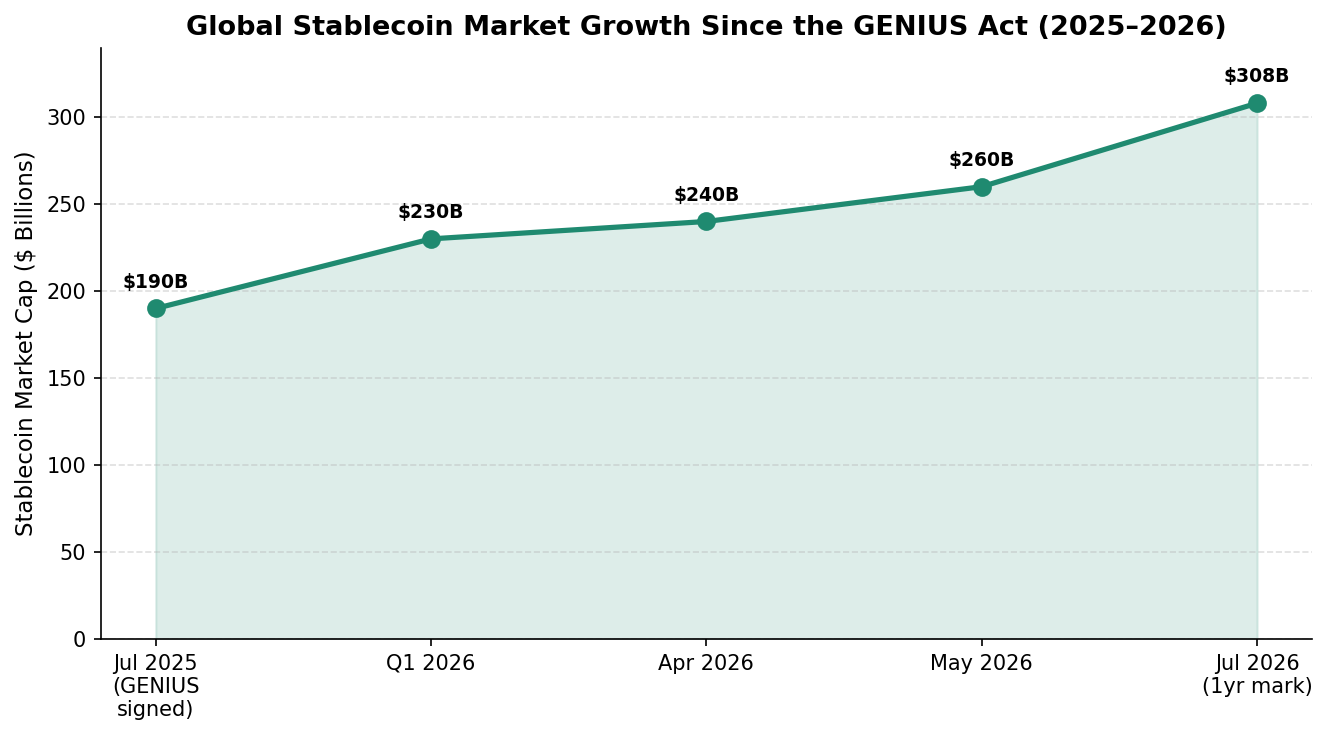
| Total stablecoin market capitalization | ~$308 billion (up from ~$260B in July 2025) |
| Growth over the past year | ~18.6% |
| USDT (Tether) circulation | ~$184 billion |
| USDC (Circle) circulation | ~$73–78 billion |
| Combined USDT + USDC market share | ~83% |
| Q1 2026 stablecoin transaction volume | ~$28 trillion (a quarterly record) |
Six agencies — the OCC, FDIC, NCUA, Treasury, FinCEN, and OFAC — each have proposed rules in some stage of the pipeline, but none finalized. That pushes the law’s full practical effect out to January 18, 2027, regardless of how the rulemaking process progresses between now and then.
The competitive picture inside the stablecoin market is shifting in a telling way. Tether, historically the dominant offshore issuer, launched a new U.S.-compliant token called USAT in January 2026, issued through Anchorage Digital Bank with Cantor Fitzgerald as reserve custodian — essentially a bet that Tether needs a domestically-compliant product to keep operating at scale once GENIUS enforcement ramps up. Circle’s USDC, by contrast, has been gaining share specifically because of its earlier alignment with U.S. regulatory expectations, and now drives a large majority of stablecoin transaction volume.
Global stablecoin market capitalization growth since the GENIUS Act was signed, based on figures reported by CryptoSlate and Blockonomi (2026).
There’s also a quieter macro story here worth flagging for readers who follow bond markets: stablecoin issuers, by virtue of holding reserves in short-term U.S. Treasuries, have become meaningful holders of U.S. government debt — a dynamic that gives Washington its own reasons to want this market to keep growing smoothly.
4. Ethereum: A Rough Stretch, Followed by an Institutional Pivot
Ethereum’s price chart tells an unusually rough story for 2026: the network closed out three consecutive negative quarters for the first time in its history, with drawdowns in the high 20% range across Q4 2025 through Q2 2026. That’s a level of sustained underperformance the asset hasn’t experienced before.
Two developments are shaping the recovery narrative:
1. The Glamsterdam upgrade. Targeted for the second half of 2026, this is described as the first meaningful base-layer throughput improvement to Ethereum since the Merge — a technical signal that development hasn’t slowed down even while the price has struggled.

2. Ethereum Institutional. On July 1, 2026, a new nonprofit called Ethereum Institutional launched with backing from Ethereum co-founder Joe Lubin along with corporate treasury holders BitMine Immersion Technologies and SharpLink Gaming. The organization claims relationships spanning more than 500 institutions — Tier 1 banks, asset managers, and sovereign wealth players representing roughly $250 trillion in combined assets under management. Its pitch is straightforward: position Ethereum as the settlement layer for tokenized real-world assets, a category where Ethereum already hosts close to 60% of the roughly $34 billion tokenized real-world asset market.
The combination — a technical upgrade aimed at throughput, plus an institutional lobbying and onboarding vehicle backed by treasury-holding public companies — suggests the Ethereum ecosystem is betting its recovery on infrastructure and institutional plumbing rather than retail speculation.
5. Solana: Down Sharply From Its Peak, But Still Working

Solana’s token price has had one of the roughest years of any major asset in this cycle, down roughly three-quarters from its all-time high near $294. Total value locked in Solana DeFi has fallen 56% from its August 2025 peak to around $5.5 billion, and the meme-coin trading activity that powered Solana’s 2025 breakout has cooled considerably.
And yet the network fundamentals tell a more resilient story:
- Solana still processed over 1 billion transactions in a single recent week, even during the depths of the price decline.
- Co-founder Anatoly Yakovenko confirmed at Consensus Miami 2026 that the Alpenglow consensus upgrade could ship as early as Q3 2026, a change that would cut transaction finality time from roughly 12.8 seconds down to about 150 milliseconds — a dramatic speed improvement if delivered on schedule.
- Cumulative spot SOL ETF inflows have crossed $1.13 billion, and corporate treasury vehicle SOL Strategies holds roughly 533,000 SOL on its balance sheet.
The gap between “price is down 75%” and “network usage remains strong” is one of the more interesting technical stories of the year, and it mirrors a pattern Crypto and Blockchain has seen before: infrastructure and adoption metrics often diverge sharply from token price during bear phases.
6. Who Actually Owns Crypto in 2026? The Demographic Picture
One of the more underreported stories this year is how much the demographic profile of Crypto and Blockchain ownership has shifted. Several major 2026 surveys — including the National Cryptocurrency Association’s annual State of Crypto Holders Report (conducted with The Harris Poll, 10,000 U.S. respondents), Security.org’s consumer report, and global data from DemandSage and Triple-A — paint a consistent picture: the base is broadening in every direction, even as young men remain the largest single segment.
Global adoption headline numbers
| Metric | 2026 Figure |
|---|---|
| Global crypto owners | ~559–560 million people |
| Global adoption rate (% of connected population) | ~9.9% |
| U.S. adults who currently own crypto | ~28–30% (Security.org); ~42% including lifetime exposure (Omni) |
| Americans who own crypto (National Cryptocurrency Association) | 67 million+ (up ~12 million from 2025) |
| Top country by adoption rate | Turkey (~25.6% of internet population) |
| Top countries by raw user count | India (~93–156 million), United States (~52 million), China (~59 million) |
| Global gender split among holders | ~61% male / ~39% female (narrowing from ~70/30 a few years ago) |
U.S. ownership by age and gender
Ownership still skews young and male, but the gap is narrowing, and the new cohort of adopters joining in 2025–2026 looks notably different from the earlier wave: this year’s new holders are more likely to be female (42%) than the pre-2025 adopter base (34%), and the age range has widened at both ends — 18% of new holders are 18–24 and 28% are 55 or older.
A few other data points worth noting for anyone writing about the “who” of Crypto and Blockchain in 2026:
- The 25–34 age bracket remains the single largest ownership segment globally, accounting for roughly a third of all crypto owners.
- Gen Z ownership is growing fastest: by some measures, around 51% of Gen Z now own or have owned Crypto and Blockchain, narrowly ahead of Millennials (~49%) and well above Gen X (~29%).
- Ownership is not concentrated among the wealthy — the National Cryptocurrency Association’s report found roughly 90% of holders fall outside the highest income brackets typically associated with Crypto and Blockchain stereotypes.
- Trust remains generational. In the Motley Fool’s 2026 survey, 68% of Baby Boomers said they don’t find Crypto and Blockchain exchanges trustworthy at all, versus 37% of Gen Z — even as both groups’ ownership numbers grow.
- Barriers to entry remain practical, not just psychological. Nearly half (48%) of non-owners say they simply don’t know how to buy Crypto and Blockchain, and 35% say they don’t know what they’d do with it once they had it — a bigger barrier, numerically, than fear of scams (32%) or security concerns (30%).
The overall picture: crypto ownership in 2026 looks less like a young-male-only phenomenon than it did a few years ago, but the “who’s new” story and the “who holds the most” story are genuinely different groups, which matters for anyone trying to design products, content, or marketing around this audience.
7. Putting It Together: What This Week Actually Tells Us
Zooming out from the day-to-day price moves, a few threads connect everything above:
Regulation is the swing factor, and it’s stuck in the middle. The CLARITY Act’s fate over the next few weeks — pass before August recess, or slip to a 2027 restart — is arguably the single biggest near-term catalyst for institutional capital across Bitcoin, Ethereum, XRP, and the exchanges and asset managers that serve them. Meanwhile, the GENIUS Act shows that even “successful” Crypto and Blockchain legislation can spend a full year without producing a single final rule, which is its own lesson in how slowly implementation moves relative to headline votes.
https://www.binance.com/en/square/post/297816343874705
Institutional infrastructure keeps being built regardless of price. Ethereum Institutional’s launch, Solana’s ETF inflows and upcoming Alpenglow upgrade, and the bifurcation of the stablecoin market into offshore (USDT) and U.S.-compliant (USDC, USAT) products all point to an industry building rails during a quiet price period rather than waiting for the next bull run to start.
The user base looks less like the crypto stereotype every year. More women, more people at both ends of the age spectrum, and ownership spread more evenly across income levels than the “young tech bro” narrative suggests — even as young men remain the plurality of holders.
Macro and geopolitics matter more than usual right now. With Middle East tensions pushing oil prices higher and weighing on risk assets broadly, Crypto and Blockchain has been trading more like a leveraged risk asset than a safe-haven hedge in July 2026 — a reminder that despite years of “digital gold” marketing, Bitcoin’s correlation with broader risk sentiment remains very much alive in periods of geopolitical stress.
For anyone tracking this space professionally — whether as an investor, a builder, or a content creator covering the industry — the message from this week’s news is less “look at this dramatic price move” and more “watch the legislative calendar and the rulemaking dockets.” The next month, running up to the Senate’s August recess, is likely to matter more for crypto’s medium-term trajectory than any single day’s candle on the BTC chart.
 By
By



 By
By