
Zcash (ZEC): The Orchard Vulnerability, the Ironwood Upgrade, and Institutional Mining
A research briefing on recent developments, current as of July 30, 2026
Executive Summary
Zcash has spent the past two months working through the aftermath of a critical, previously undetected soundness bug in its Orchard shielded pool, first disclosed on May 29, 2026. The flaw, present since Orchard’s 2022 launch, could theoretically have allowed an attacker to mint counterfeit ZEC without leaving any visible trace, because Orchard’s privacy design makes individual transactions unverifiable to outside observers. The network patched the exploit path within days, but a harder problem remained: nobody could cryptographically prove that the bug had never been used. That gap in verifiability, more than the bug itself, drove ZEC’s price down sharply in early June.
Zcash’s response was the Ironwood (NU6.3) network upgrade, which activated on schedule on July 28, 2026. Ironwood retires the old Orchard pool to new deposits and routes any funds leaving it through a public accounting checkpoint called a turnstile, which cannot let more ZEC out than was verifiably deposited. This restores a public way to check the integrity of the supply without exposing anyone’s private balances. Alongside this technical story, Digital Currency Group’s Zcash-mining subsidiary, Fortitude, has disclosed rapid production growth, a large new mining facility aimed at cutting costs, and a proposed Nasdaq listing — signals of growing institutional involvement in the network.
1. The Orchard Vulnerability: What Happened
On May 29, 2026, security researcher Taylor Hornby, working with Shielded Labs and using an AI-assisted audit workflow built on Claude Opus 4.8, identified a soundness flaw in the halo2_gadgets cryptographic circuit underlying Zcash’s Orchard shielded pool. In a zero-knowledge proof system, soundness is the property that the protocol only ever accepts valid state transitions. This bug broke that guarantee: in principle, it could have allowed an attacker to forge transactions and mint ZEC inside Orchard without detection.
Developers moved quickly. An emergency network upgrade patched the exploit path by June 2–3, 2026. But because Orchard hides transaction amounts and participants by design, the same privacy properties that protect legitimate users also made it impossible to prove, after the fact, whether the bug had ever been exploited. ZEC’s price fell more than 30–50% in the days following disclosure, briefly touching roughly $40 before starting to recover as the community’s response took shape.
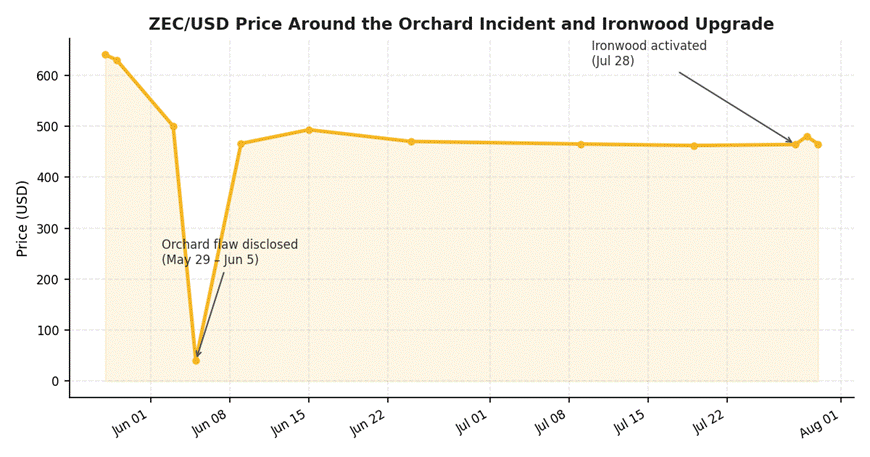
Figure 1. Approximate ZEC/USD price path around the Orchard disclosure and the Ironwood activation. Illustrative reconstruction from multiple market data sources; not an official price feed.
Read More about the Previous Development in ZEC
Zcash’s Wild 2026: From SEC Clearance to 30x Multi Year Rally
2. The Ironwood Upgrade: Restoring Verifiable Supply
Zooko Wilcox, Zcash’s founder, together with Shielded Labs’ Jason McGee and researcher Taylor Hornby, proposed the Ironwood upgrade within days of the disclosure. Its purpose is narrow but important: give users a way to verify Zcash’s circulating supply without trusting any company or foundation, and without exposing private transaction data.
Ironwood works through a mechanism called a turnstile. After activation, the legacy Orchard pool stopped accepting new deposits and was restricted to withdrawals only. A brand-new pool, also using the Orchard proof system but with a formally verified, patched circuit, opened at zero balance. As users migrate funds out of the old pool and into the new one, the turnstile enforces a simple rule: total withdrawals from the old pool can never exceed the amount that was legitimately deposited into it. Any counterfeit ZEC that might exist would be blocked at that gate and could never reach general circulation.
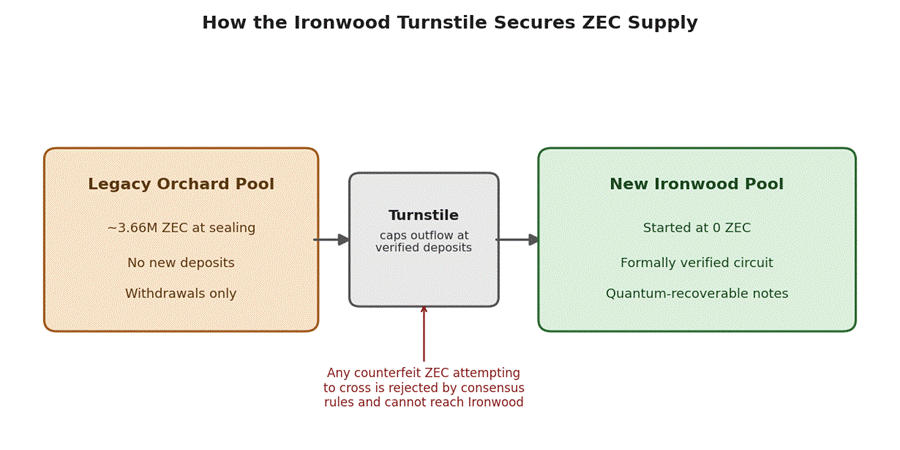
Figure 2. Simplified illustration of how the Ironwood turnstile isolates the legacy Orchard pool from the new pool.
The upgrade activated on schedule at block height 3,428,143, on July 28, 2026, as part of the NU6.3 hard fork. At the moment of sealing, the Orchard pool held on the order of 3.6–3.8 million ZEC (roughly $1.7 billion at the time). Ironwood also introduces quantum-recoverable notes under ZIP 2005 — a structural change that would let a future recovery protocol reclaim funds if quantum computing ever broke current elliptic-curve cryptography. Developers are careful to note this is not the same as being quantum-secure today; a separate recovery mechanism would still need to be built and activated.
On supply verification specifically: as of publication, third-party trackers (CoinGecko, CoinMarketCap, CoinGlass) put ZEC’s circulating supply at approximately 16.79 million coins against the fixed 21 million cap. A widely circulated figure of exactly 16,848,458 ZEC attributed to Zooko Wilcox could not be independently confirmed in the sources reviewed for this report and should be treated as unverified pending an on-chain or official citation; the order of magnitude, however, is consistent with published data.
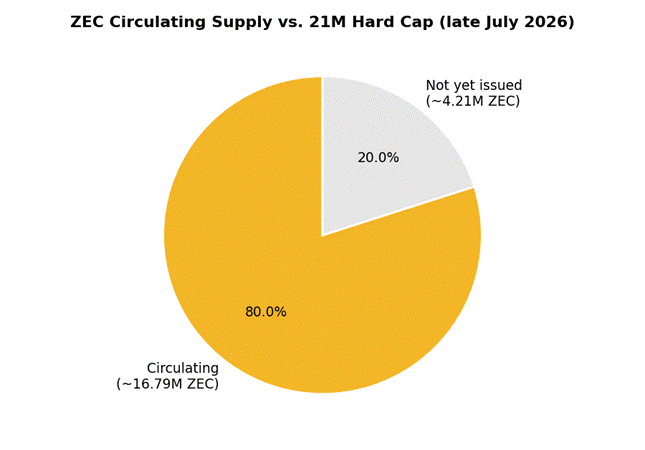
Figure 3. ZEC circulating supply relative to the 21 million hard cap, based on aggregated exchange and tracker data for late July 2026.
3. Institutional Mining: Fortitude and DCG
Digital Currency Group’s mining subsidiary, Fortitude Mining, has become one of the most visible institutional players in Zcash. In a preliminary SEC proxy filing tied to a proposed all-stock merger with Nasdaq-listed HeartSciences (which would take Fortitude public under the ticker “TUDE”), Fortitude disclosed that it mined 72,696 ZEC in the six months ended June 30, 2026 — about 28% of total network production over that period.
On July 28, 2026, Fortitude also brought online a new 12-megawatt, self-built mining facility in Grand Island, Nebraska — its first ground-up (“greenfield”) site. The company said cheap contracted power (about $0.045/kWh) combined with newer-generation hardware is expected to cut its direct cash cost of mining ZEC from roughly $70 to about $40 per coin. That facility pushes Fortitude’s total contracted power capacity above 60 MW across seven sites.
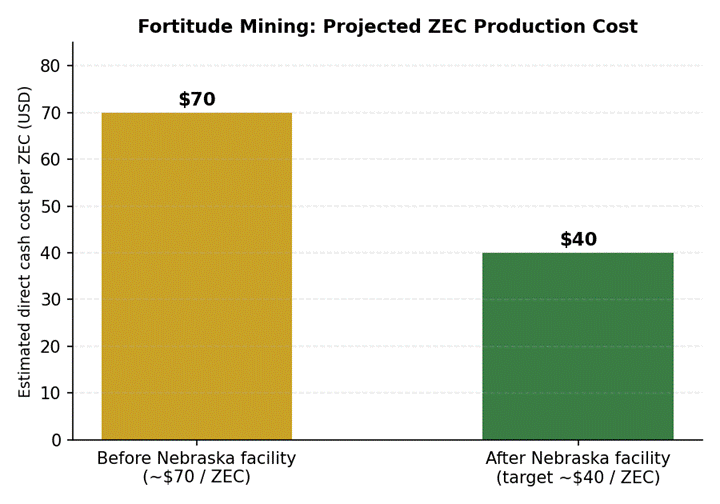
Figure 4. Fortitude’s projected direct cash mining cost per ZEC, before and after the Nebraska facility comes fully online. Figures are company projections, not audited results.
Separate reporting on Fortitude’s SEC disclosures offers a more mixed picture: the company carries real debt (an $26 million credit facility drawn against for $8.3 million as of the filing) and posted a net loss in 2025, with only about 28% of that year’s revenue coming from ZEC mining itself (the remainder from Bitcoin and other assets). DCG founder Barry Silbert has said publicly he believes Zcash could eventually reach 5–10% of Bitcoin’s market capitalization — a bullish long-term thesis, though one investors should weigh against the company’s current financial position.
4. Investor Sentiment
Putting the technical and institutional threads together, sentiment around ZEC in late July 2026 is genuinely mixed rather than one-sided:
| Bullish factors | Bearish / cautionary factors |
| Ironwood upgrade activated on schedule (Jul 28), closing the Orchard trust gap | ZEC remains far below its pre-incident and all-time-high levels |
| Turnstile design gives a public, non-invasive way to check that no counterfeit ZEC entered circulation | Full confidence requires the Orchard migration to play out over weeks/months, not an instant fix |
| Continued institutional mining investment (DCG/Fortitude) and a proposed Nasdaq listing | Fortitude’s own disclosures show real losses, debt, and reliance on non-ZEC mining revenue historically |
| Lower projected mining costs (~$40 vs ~$70/ZEC) could improve miner economics if realized | Privacy-coin regulatory uncertainty persists in multiple jurisdictions |
| Formal verification and quantum-recoverable notes aim to reduce recurrence of similar bugs | Some privacy advocates flag temporary metadata/privacy trade-offs during migration |
5. Key Facts at a Glance
| Item | Figure / Status | Note |
| Circulating ZEC supply | ~16.79M ZEC | Trackers (CoinGecko, CMC, CoinGlass) show 16.79M–16.80M as of late July 2026 |
| Max supply cap | 21,000,000 ZEC | Fixed, enforced by consensus + turnstile accounting |
| ZEC price (Jul 30, 2026) | ~$460–$480 | Down from all-time high near $3,192; still far above pre-2025 levels |
| Orchard flaw disclosed | May 29 – Jun 5, 2026 | Soundness bug in halo2_gadgets circuit, present since 2022 |
| Emergency patch | Completed Jun 2–3, 2026 | Closed the exploit path; did not itself restore supply verifiability |
| Ironwood (NU6.3) activation | Jul 28, 2026, block 3,428,143 | Sealed Orchard to withdrawals-only; new pool starts at zero ZEC |
| Orchard pool value at sealing | ~3.66–3.76M ZEC (~$1.7B) | Must migrate out through the turnstile |
| Fortitude 6-month ZEC output | 72,696 ZEC (~28% of network output) | Disclosed in HeartSciences/Fortitude SEC proxy filing, Jul 29, 2026 |
| Fortitude mining cost target | ~$70 → ~$40 per ZEC | Tied to new 12MW Nebraska facility, not a completed fact yet |
6. Bottom Line
The Orchard vulnerability was a serious, structural problem — a four-year-old soundness bug in privacy-preserving code that, by design, could not be ruled out retroactively through inspection alone. Zcash’s response, culminating in the July 28 Ironwood activation, is a reasonable and relatively fast engineering answer: it doesn’t claim certainty about the past, but it does restore a mechanism for verifying the present and future supply without requiring trust in any single party. Institutional mining investment from DCG’s Fortitude adds a layer of capital commitment to the network, though Fortitude’s own financial disclosures suggest that commitment has not yet been effortless or risk-free.
As with any fast-moving, story-driven crypto asset, individual figures circulating in social media and aggregator posts (including specific supply numbers attributed to founders) are worth checking against primary sources — the Zcash Community Forum, ZIP specifications, and audited financial filings — before being treated as settled fact.
Sources
- Zcash Community Forum — “The Orchard Counterfeiting Vulnerability—And Next Steps” and the related Ironwood proposal
- The Block — coverage of Ironwood activation and the Fortitude Nebraska facility
- Decrypt, CoinDesk, crypto.news, Cryptonomist — Ironwood (NU6.3) activation reporting (Jul 28–29, 2026)
- Blockonomi, KuCoin/Odaily, BeInCrypto, Bitcoin Foundation News — Zooko Wilcox / Jason McGee statements on the Orchard flaw and supply verification (June 2026)
- GlobeNewswire / Manila Times — HeartSciences–Fortitude Mining preliminary proxy statement (Jul 29, 2026)
- Protos, CoinMarketCap Academy, Bitcoin.com News (FR) — Fortitude financials and Nebraska facility details
- CoinGecko, CoinMarketCap, CoinGlass, Coinbase, TradingView, CryptoRank — ZEC price and circulating-supply data (late July 2026)

 By
By



 By
By